




First State history
Hoffecker discusses Delaware history at UDARF lecture


10:29 a.m., Nov. 18, 2011--A change of professors in an undergraduate history class changed the direction of Carol Hoffecker’s career as an academic and author.
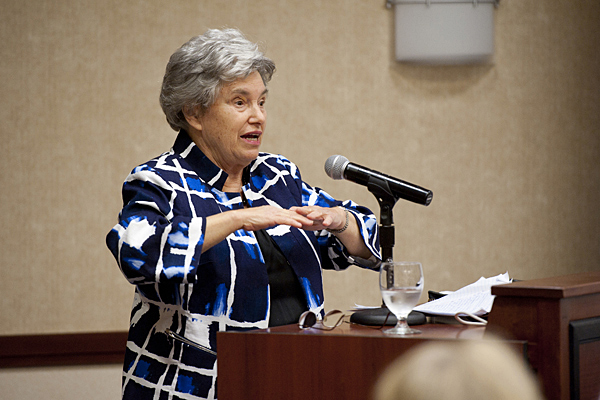
Hoffecker, the Richards Professor Emerita of History at the University of Delaware, shared her story during the third “My Intellectual Journey” lecture, held by the University of Delaware Association of Retired Faculty on Thursday, Nov. 10, at the Courtyard Newark at the University of Delaware.
People Stories

'Resilience Engineering'
Reviresco June run
During her three decades on the UD faculty, Hoffecker served as associate provost for graduate studies and chaired the Department of History.
Honors for Hoffecker include the Francis Alison Faculty Award, the E.A. Trabant Award for Women’s Excellence, the UD Medal of Distinction and the College of Arts and Sciences Distinguished Lifetime Service Award.
The graduate of Mt. Pleasant High School in Wilmington, Del., recalled how she and other UD undergraduates were moved from a History 105 class taught by Evelyn Holst Clift to a different section under Walther Kirchner.
Hoffecker said that while Clift’s special area of interest was the year 1066 (the Battle of Hastings), Kirchner’s focus was 1077 (the year Henry IV, king of the Germans and later Holy Roman Emperor, begged for forgiveness and was pardoned by Pope Gregory VII at Canossa, Italy).
“Because of this, I learned a lot about what happened in 1077 and when I took my GRE test at Swarthmore it seemed whoever prepared that test also thought a lot about 1077,” Hoffecker said. “The result was that I did very well, qualifying for graduate school at several top universities, including Yale and the University of Wisconsin. I chose Harvard.”
Although she enjoyed a Harvard education that included classes with professors such as Frank Freidel, author of Franklin D. Roosevelt: A Rendezvous with Destiny, and Oscar Handlin, author of The Uprooted: The Epic Story of the Great Migrations That Made the American People, Hoffecker opted to return to her native Delaware to write about a city that was once one of the major manufacturing centers of the Mid-Atlantic region.
“I loved Boston and Cambridge and I learned a lot from all of those people at Harvard,” Hoffecker said. ”I also knew that I wanted to do urban history, and I knew that I should write about Wilmington, Del.”
Working as a resident scholar in the UD Department of History’s Hagley Graduate Program, Hoffecker wrote Wilmington: An Industrial City 1830-1910, a book that illuminated the city’s manufacturing past.
“In the 19th century, Wilmington had lots of factories and was a big producer of railway cars and wheels and river boats, and the Brandywine River was ideal for powering wheat and later corn mills,” Hoffecker said. “The people who built those mills were Quakers, and there are several streets in Wilmington named for them.”
While Wilmington’s industrial heyday was long gone by the early 1900s, the city still remained important because DuPont had decided to build offices and research facilities in and near the city.
“Wilmington also had a history of racial segregation in its schools and housing, and this created a tension between those living in the old two-story houses in the city and those living in larger homes in the suburbs,” Hoffecker said. “If you want to understand how we got the muddle that led to the riots in 1968, this book is a good place to start.”
Delaware’s middle and southernmost counties also are represented in books by Hoffecker that include Delaware, a Bicentennial History (Norton, New York, 1977) and Honest John Williams U.S. Senator from Delaware (UD Press, 2000).
Williams, the conservative senator from Millsboro, had earned a reputation for integrity and also garnered national attention for his investigation of the Internal Revenue Service and of Bobby Baker, the secretary to the majority leader, then Lyndon Johnson.
“The difficulty in writing about John Williams is that while he was in Washington, D.C., his wife, Elsie also stayed there, and they spent most weekends at home so there was little need for correspondence with family or friends,” Hoffecker said. “This was unlike President John Adams, who stayed in Philadelphia while his wife Abagail remained home in Quincy, with the result that they wrote a lot of letters to each other.”
A reception followed the lecture.
Article by Jerry Rhodes
Photo by Kathy F. Atkinson