

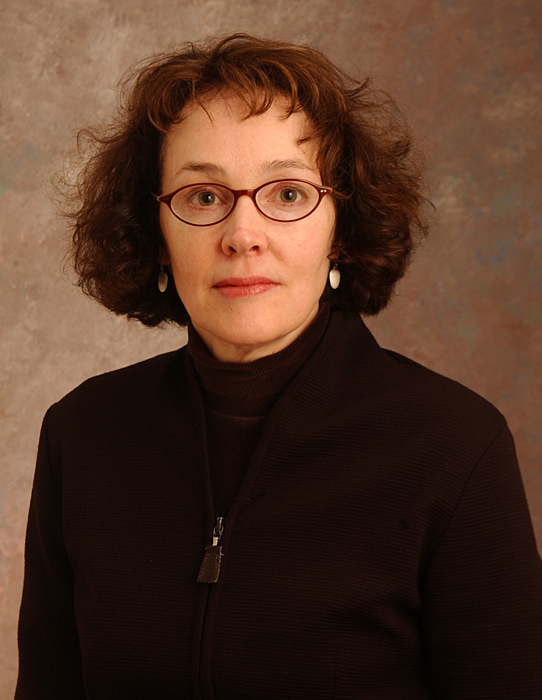
Werth will spend one semester at the Clark Art Institute and a second semester at the Centre Allemand, which is known for its strong focus on French art and culture.
“I am thrilled to have this opportunity to conduct research in both Williamstown and Paris, and to have time to write,” Werth said.
“This is a distinguished and well-earned honor,” Bernard Herman, Edward and Elizabeth Rosenberg Professor of Art History and chairperson of the department, said. “The work Prof. Werth will undertake during the fellowship will lead to the publication of her second book and inform her teaching at all levels.”
Werth's new book has the working title of Faces: Painting, Photography, Film, and Literature, 1860-1930. “My project explores how the human face is represented in painting, photography, literature, and early film from 1860-1930,” Werth said.
“In this period more and more images of the face were produced and circulated, and forms of attention and response to the face changed rapidly. The face was a site of experimentation for painters and writers, and for photographers and filmmakers. My goal is to examine these representations within a context of social and intellectual change, such as the emergence of mass advertising, new media, and new forms of entertainment, as well as developments in psychology, criminology, ethnography and evolutionary studies. My study must be interdisciplinary in order to understand these shifts,” she said.
In early films, for example, facial close-ups were first considered vulgar, but viewers quickly adapted and learned to appreciate greatly enlarged images of the face on the screen, Werth said. Painters and print-makers from the impressionists to the Cubists experimented with the face, sometimes disfiguring it to the point of illegibility or monstrosity. One important aspect of her work will be drawing connections between different media-including the relations between text and image-and another will be considering how the face becomes a focus of discussions about modernity, Werth said.
Werth received her master's and doctoral degrees from Harvard University, and came to UD in 2001 from Barnard College, Columbia University. In 2003, she organized a day long symposium on modern portraiture at UD. Her first book, The Joy of Life: The Idyllic in French Art, Circa 1900, explores dreamlike representations of mythic community, individual fantasy, utopianism, and joie de vivre in French painting from 1890 to 1917, focusing in particular on three artists, Henri Matisse, Puvis de Chavannes, and Paul Signac.
Article by Sue Moncure
Photo by Kathy Atkinson