

Keeping up with the Jones Collection
Keeping up with the Jones Collection
The impact of the University’s Paul R. Jones Collection of African American Art reached far beyond its gallery walls this summer, as students—from UD and around the country—and faculty made wide-ranging use of the collection’s rich resources.
Summer 2006 featured the inaugural Paul R. Jones Student Leadership Conference, which drew 45 participants from several colleges and universities to the Newark campus; the first group of Paul R. Jones Summer Scholars, consisting of five students from various schools who were paired with UD faculty members to conduct original research; and a brand-new Winterthur-UD internship program, in which students developed art conservation skills by helping to restore a damaged mural.
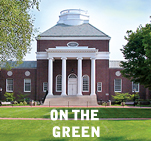
The Paul R. Jones Collection is among the world’s oldest, largest and most complete holdings of works by 20th Century African-American artists. Jones, an Atlanta businessman and lifelong art collector, donated his collection to the University in 2001, and UD renovated the historic Mechanical Hall to house it.
Speaking at the leadership conference in June, Jones called the event a personal “dream come true.”
“It is my opinion that the art world, as a result of the Paul R. Jones Collection coming to the University of Delaware, and the University’s response to it, and the collaboration that has flowed from all of that, means that education in a new century—and we are only six years into it—will never be the same,” he said.
Jones said it was part of his dream in giving the collection to the University that it would foster interaction between the institution and historically black colleges and universities. Shortly after the gift, UD signed an agreement with Spelman College that has resulted in an ongoing exchange of students, faculty and exhibits. A similar partnership was launched earlier this year with North Carolina Agricultural and Technical (NCA&T) State University. (See sidebar on next page.)
Beverly D. Tatum, president of Spelman College, also spoke at the conference, telling the audience that Jones’ vision of using his collection to develop connections among institutions was an important one.
“Having access to the art allows us, as an African-American community, to deepen our knowledge of ourselves, but having this bridge of art between Spelman and the University of Delaware creates an opportunity for us to get to know others in ways that might not otherwise be possible,” Tatum said.
The four-day conference, “The Art of Leadership: Developing Creative Student Leaders,” drew participants from UD, Spelman and NCA&T, as well as Morgan State, Delaware State, Lincoln and Cheyney universities. The conference included a workshop in Mechanical Hall that merged social observation with art.
Workshop facilitator Audrey Helfman, associate professor in the School of Urban Affairs and Public Policy’s leadership program, asked participating students to think about snap judgments and communication barriers by assessing their immediate reactions to certain works from the Jones Collection.
“It’s human nature to gravitate to what we feel comfortable with,” Helfman told the students. “But, as with both art and social situations, the deeper you look, the less clear-cut the initial picture becomes and the more you find yourself needing to develop your vision.”
Co-facilitator Janet Broske, curator of University Museums, told the workshop participants that everyone brings “personal baggage” when viewing works of art.
“To overcome biases, we need to become more effective viewers, and I think that plays into the theme of leadership because art creates that bridge,” Broske said. “Art is supposed to invite you in and make you comfortable, but it’s also supposed to draw you out of your comfort zone.”
Another initiative utilizing the collection, the Paul R. Jones Summer Scholars Program, brought five students to campus for five weeks to work one-on-one with faculty members in developing their analytical skills in the visual arts. The students conducted scholarly research, produced written reports and delivered oral presentations featuring images from the Jones Collection.
The student-faculty teams also used the collection as the starting point for research, lectures, publications, field trips, media productions and course development. Those activities included touring Winterthur Museum, attending a gala at the Delaware Art Museum and participating in a Graduate Record Exam preparation program and a lecture on how to apply to graduate schools.
“From our second trip, to the Delaware Art Museum, we could already see a difference in the students’ knowledge of art,” Santiba Campbell, a UD doctoral student, said. Campbell served as coordinator of the program, which was directed by James M. Jones, professor of psychology and director of the University’s Black American Studies Program.
The students had a variety of backgrounds, interests and summer projects.
For Eric Sudler, a psychology major at Morehouse College in Atlanta, viewing Charles White’s powerful oil-wash portrait of John Henry in the Jones Collection moved him to study a phenomenon named for the legendary railroad worker who worked himself to death trying to outperform a machine.
John Henryism is the belief that the psychological stress caused by persistent social and economic oppression contributes to health problems in African Americans.
“I’m learning a lot about what pushes us, what motivates us to go that hard, what drives us to go that far,” Sudler said after beginning his summer research. “And, I start to think of what was going on in the artist’s life when he painted that.”
Jones Scholar Amanda Vasilikos, AS ’07, who hopes to work as a journalist covering the arts, called the summer program “a wonderful learning experience.” She added, “I really didn’t know much about African-American history before. I’m just kind of taking it all in.”
In the case of Kira Johnson, a history major at NCA&T, visiting Delaware and learning about the Jones Collection were both new experiences. “I’ve never used art to connect to history,” she said, “and I thought it would be a unique experience to connect the two.”
At the same time that the Jones Scholars were working on campus, six undergraduates from UD and Spelman College were getting hands-on lessons in art conservation in a new four-week internship program at Winterthur Museum and Country Estate.
Overseen by Joyce Hill Stoner, UD professor of art conservation, and Peggy Olley, project coordinator and a researcher at UD, the program was designed to introduce students to the prerequisites for admission to graduate school in art conservation while also providing them with direct experience in paintings conservation.
The students helped repair areas of a large, damaged mural owned by Hampton University and painted in 1947 by John Biggers, an African-American artist featured prominently in the Jones Collection. The interns also studied three other paintings by artists included in the collection, as well as learning about the life and work of Biggers.
“Part of our interest as conservators is always the artist behind the work,” Olley said. She said working on the 5-by-12-foot mural Baptism provided students with some unusual conservation issues, and its idiosyncratic nature required them to dig more deeply into its history. The mural became damaged when Biggers rolled it up for storage, causing some dents and paint loss.
Students were selected for the internship based on academic standing and interest level. They lived in the same residence hall during the summer and carpooled to Winterthur.
“I haven’t had a lot of exposure to African-American art, and this program has really opened my eyes to artists I wasn’t familiar with before,” said Stephanie Oman, AS ’08, a double-major in art conservation and art history. “It’s also nice to live in the dorms with students from other parts of the country, because everyone’s experiences are so different.”
Regina Branch, a Spelman College art history major, said the internship helped her plan for a career, possibly in museum work.
“Studying art history in college, we’re taught that the paintings are important and the artists are important, but we never really learn what goes into saving these artworks,” she said. “I’ve learned so much [this summer] that a whole new world of knowledge has opened up.”