What Now?
At this point we're still lacking any explanation for
why we don't see firms going to 100% debt financing or paying zero taxes.
In other words, we haven't identified any offsetting costs to adding debt
to the capital structure. Merton (1977) identifies one potential cost.
Merton (1977):
- argued that we should ignore direct costs of bankruptcy
because they're essentially trivial relative to the potential tax benefits
- recognized that taxes are also paid at the personal level
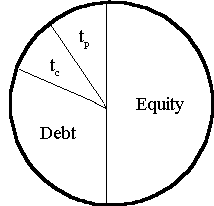
- personal tax rates on debt income are higher than personal
tax rates on equity income
- tax benefits of debt at the corporate level are offset
by the tax disadvantage of debt at the personal level
Taxes on debt and equity income:
- Corporate debt
- interest is ordinary expense
- interest is ordinary income (assume par bond)
- Equity
- dividends are ordinary income
- capital gains
- depends on time period
- not taxed if pushed into estate
- only realized capital gains taxed (time value benefit)
Consider a debt-for-equity swap
in Merton's world:
- corporate tax liability goes down, but
- personal tax liability increases because investors holding
more tax disadvantaged debt and less tax advantaged equity
- benefit of decreased corporate tax liability is exactly
offset by the cost of increased personal tax liability
Aggregate and Firm Debt Levels
(Merton)
Assume:
- personal tax rate on stock income is zero
- required rate of return on equity equals the required
rate of return on tax exempt securities, re=r0
- all bonds are riskless
- no transactions costs
- one corporate tax rate, tc, across all firms
- personal tax rate, tp, varies across individuals
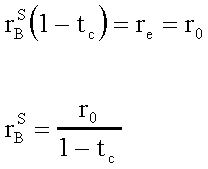
Firms indifferent between debt
and equity when:
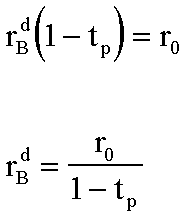
Investors' demand for debt is
given by:
Note:
- Tax exempt entities have a comparative advantage in buying
corporate debt.
- Marginal individual changes along demand curve
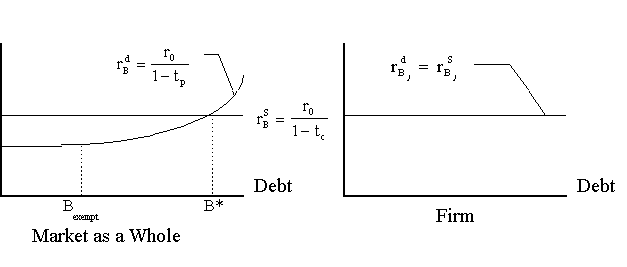
Miller's work brings us back to the conclusion that (even
with taxes) financial policy is irrelevant.
Criticism: Miller abstracts
from tax code
- DeAngelo and Masulis (1980)
- Brennan and Schwartz (1978)

