In what follows we provide detailed answers to these questions for University of Delaware, but first let us make a short summary.
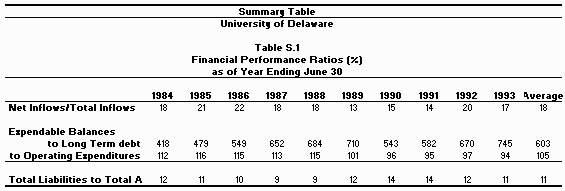
While an examination of all aspects of the finances are essential to a good understanding, Financial Performance Ratios can give a reasonably good overall evaluation of financial activity. The four ratios of table S.1 indicate that:
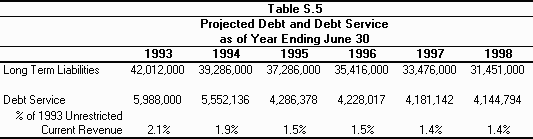
While NTI at 17%, is down from 20% in FY92, that year appears to have been unusually high. The graph in Appendix B shows the NTI ratio well above the sample 75th %tile. The Expendable Balance/Debt ratio increased from 670% and the Expendable Balance/Expenditure ratio decreased from 97%. There was a decrease in the Liability ratio from 12%. All except the slight decline in the Expenditure ratio were good changes.
The pie-charts of Figure 7 give an indication as to what has been done with financial resources over and above needs for ongoing expenditures. For the four-year period ending FY93 about 95% of what one might call "extra resources" were supplied by ongoing operations and 5% by increased liabilities. This shows a reduction from the 8% supplied by debt in our last report. Nearly 72% of these assets were used to increase Plant and 24% to increase Endowment & Similar Funds.
As shown on table S.2, Net Total Assets (called Fund Balances), perhaps the most significant indicator of university financial health, have increased at an average annual rate (APR) of 7.6% to over $639 million. With a decline in debt, the TL/TA ratio dropped from 12% in FY92 to 11% in FY93.
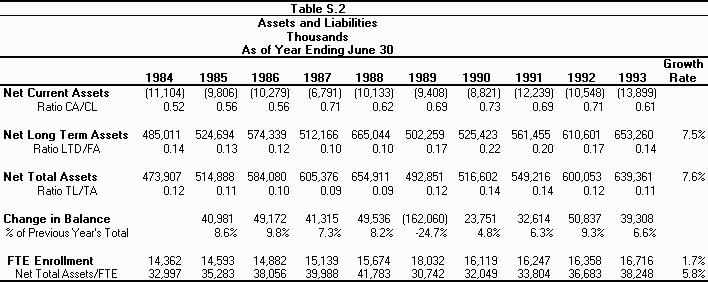
Net Current Assets remained in the negative range over the whole period, ending at $(14) million. Thus, the CA/CL ratio remained a fraction varying from 0.52 to 0.73, ending at 0.61.
Ordinarily, in for-profit business, negative Net Current Assets and a ratio of less than 1.0, would suggest the possibility of trouble. However, in this case, and more frequently in the case of many colleges/universities, this is not so. The university is taking advantage of changes in financial markets that make it possible to invest short-term funds (needed in less than a year) in various money market instruments, rather than hold them as checking or short-term savings accounts, and still maintain adequate liquidity. The invested assets earn more income for the university than would be gotten from a checking account. Examination of the details of the university's financial investments indicates University of Delaware has adequate short-term liquidity. (See table 1a showing the distribution of financial assets.)
Net Long-term Assets grew at an APR of 7.5%, increasing by $42 million to $653 million in FY93. With liabilities increasing less rapidly than physical assets the LTD/FA improved from 17% in FY92 to 14% in FY93.
FTE enrollments increased steadily throughout the period at an APR of 1.7% to 16,716. With Net Assets growing at a higher rate, Net Assets per FTE grew at an APR of 5.8% to $38,248.
Of particular importance to colleges and universities is the expendable part of Total Fund Balances. Expendable balances shown on table S.3 increased by $6 million to $313 million during the ten years, an APR of 7.2%, with unrestricted balances growing by $9 million and restricted balances declining by $(3) million.
The overall growth in Expendable Fund balances and especially in unrestricted balances increased financial flexibility. The result is an amount of expendable balances sufficient to cover 745% of long-term debt, up slightly from 670% in FY92; or 94% of current expenditures and mandatory transfers, down slightly from 97%.
Non-expendable balances increased by $4 million since FY92 to $67 million in FY93, growing at a nine-year average APR of 9%. These include $57 million of Endowment & Similar balances, a relatively high amount for a state university. Recent endowment growth has increased to 12% from its long-term 11%
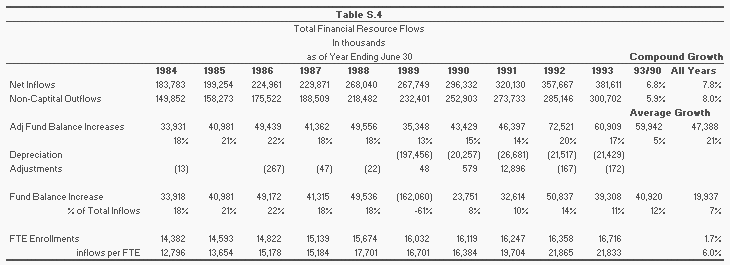
Total inflows are the source of resources to cover ongoing expenditures. Table S.4 shows total inflows growing to $362 million at an APR of 7.8% and total outflows increasing to $301 million an APR of 8%. Inflows per FTE grew at an APR of 6% to reach $21,633.
The distribution of sources of inflows (see tables 4, 5a and 5b) indicates tolerance for broad swings in student enrollment without severe loss of income (providing state appropriations are not varied in direct proportion to enrollments):
                       SOURCES OF INFLOWS
                          ($ millions)

                   Students         159    44%
                   State             77    21%
                   Government        58    16%
                   Investment        30     8%
                   Private           22     6%
                   Sales & Service   12     3%
                   Other              4     1%
Total resources left after operating expenditures and deductions
for the four years ending FY93 come to $232 million (see table 8).
These were used to increase:
                    USES OF "EXTRA" RESOURCES
                          ($ millions)

                    Plant Funds           166
                    Endowment Funds        55
                    Current Funds           9
                    Debt Reduction          2
The "bottom line" is a financially healthy university with high and
increasing Fund Balances, including substantial Expendable Balances
and Endowment Fund Balances. Both inflows and outflows show strong
growth. By comparison to prior years, financially, FY93 was a very
good year. An excellent financial position was markedly enhanced
by strong growth in both Fund Balances and Financial flows.
