In many universities throughout the United States, faculty are being led to believe that the financial position of their university is fairly secure; but at present money is tight, it has been tight over the recent past, and the prospect is that it will continue tight in the immediate future. University of Delaware may be no exception.
The financial statement counterpart to the college's Operating Budget is the Statement of Current Funds Revenues, Expenditures and Other Changes; herein called Current Operations. [ACU p55] Unless otherwise specified this and all following references are taken from Audits of Colleges and Universities, 2nd, AICPA, NY, NY 1975. The number at the end of the text is the page number of the reference. It shows the actual outcome of the Operating Budget plan for the year as the year comes to a close.
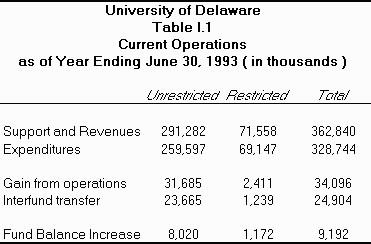
A look at table I.1, which shows the outcome of the Current
Operations of the University of Delaware for the year ending June
30, 1993, reveals that for the academic year there was an increase
of $9.
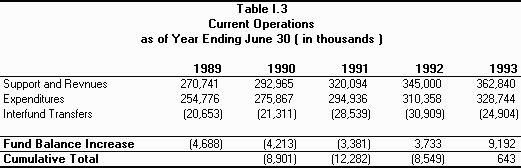
Similarly,
table I.3 shows a series of gains and losses
with a five-year increase of $640 thousand.
These facts are true, but they are not the whole truth. Current Operations as depicted on the Statement of Current Funds Revenues, Expenditures and Other Changes is just one of the budgets used by the college. If all financial resources received and disbursed by the college are considered, a quite different view emerges.
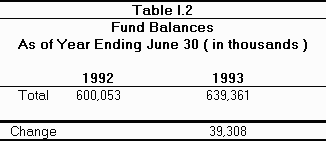
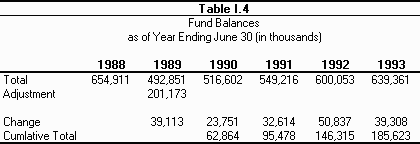
Examining the outcome for all the college's budgets as reported on
tables I.2 and I.4 reveals that actually there was a considerably
larger gain in Fund Balances of $39 million for the year ending
June 30, 1993 and gains for each year 1989 through 1993 resulting
in an increase of $186 million for the whole period.
Figures 1a
and 1b give a graphical view of this anomaly.
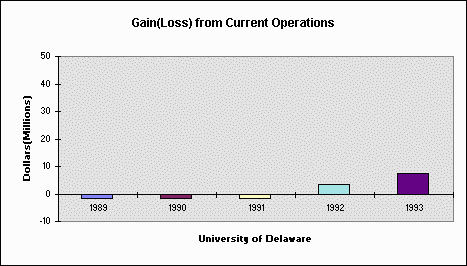
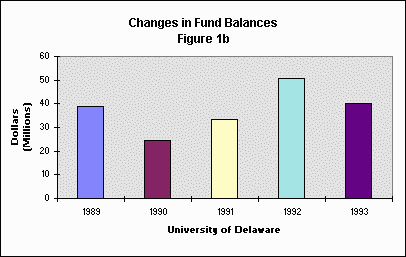
Comparing the Statement of Current Funds Revenues, Expenditures and Other Changes as reported on table I.3 showing an increase of $640 thousand for five years with the Change in Fund Balances as reported on table I.4 showing a gain of $186 million makes us wonder if looking at the Operating Budget is the right way to determine the financial health of the college. In fact, it is not. The Current Funds statement is not intended to show the complete financial picture of the college.
[The] Statement of Current Funds Revenues, Expenditures, Transfers and Changes in Fund Balances - is a summary of the financial activity of the current funds during a fiscal year. It does not represent the entire operations of the period (there is financial activity recorded in the other funds), nor does it reflect the net income or loss for a fiscal year.
[The] Statement of Changes in Fund Balances - is a summary of all the additions to and deductions from each of the major fund groups and subgroups during a fiscal year. This statement provides an overview of the University's financial activity during a fiscal year.
Thus, the document to look at is the Statement of Changes in Fund Balances, not the Operating Budget (Current Operations). To that end, we present an analysis of the financial health of University of Delaware based on an examination of total financial receipts and disbursements as shown in the Statement of Changes in Fund Balances along with its companion documents the Statement of Current Funds Revenues, Expenditures and Other Changes and the Balance Sheet.
