




Democracy and incarceration
Yale's Jason Stanley discusses propaganda, politics, mass incarceration


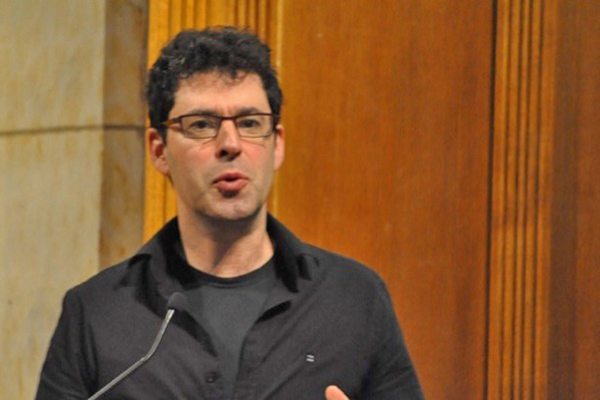
1:26 p.m., Oct. 28, 2015--One in three Delaware eighth-graders have had a family member incarcerated, while for one in 10, their own father has been incarcerated, Jason Stanley told an audience at the University of Delaware in a recent lecture.
Such alarming incarceration rates in the United States – which accounts for 25 percent of the entire population of world prisoners – can be traced back to political and media propaganda, said Stanley, professor of philosophy at Yale University.
People Stories

'Resilience Engineering'
Reviresco June run
“[The media focuses] on idealogic partial stories,” he said. “No one can ever tell the full story of social reality. However, everyone thinks they can.”
The American Philosophical Association award-winning author spoke Oct. 23 in Mitchell Hall, delivering the fall 2015 David Norton Memorial Lecture titled “The War on Thugs: Propaganda, Politics and Mass Incarceration.”
Society, Stanley argued, can perpetuate a negative political culture that he believes needs to be the focus for political change rather than reform through legislation. In his lecture, he discussed the Soviet-like high mass incarceration rates in the United States and the long-term effects he said it has left – and will continue to leave – on political culture.
He focused on how people develop their self-identities through life and how these ideals are used to formulate responses to mass incarceration, propaganda and politics, citing the U.S. history of slavery as an example.
“With slavery, it was not hard to see what was going on, and people formed the belief that this was good for society,” he said.
Stanley also spoke about race and its implications on the U.S. justice system, quoting a Colorado judge who once said, “The bottom line is the American justice system is not racist.” Stanley used this as one of several examples of what he saw as propaganda undermining the unbalanced and unequal justice and legal systems.
“We all have an identity that is formed from where we come,” he said. “This is why racism still exists in America.”
Stanley closed his lecture with an urge to ban dehumanizing discourse, such as descriptions of “thugs” or black American “gang members.”
“Society,” he said, “has prevented public discourse from changing.”
The David Norton Memorial Fund supports this lecture each year in remembrance of the late UD philosophy professor.
Article by Christopher Razzano