






Imagination as freeing force
Imagination is an important force for discovery and freedom, Nafisi says


11:57 a.m., Nov. 17, 2011--The sweet taste of strawberries and the sight of Mt. Damavand in a halo of snow are among “the small things” that exiled professor and author Azar Nafisi misses about her native Iran.
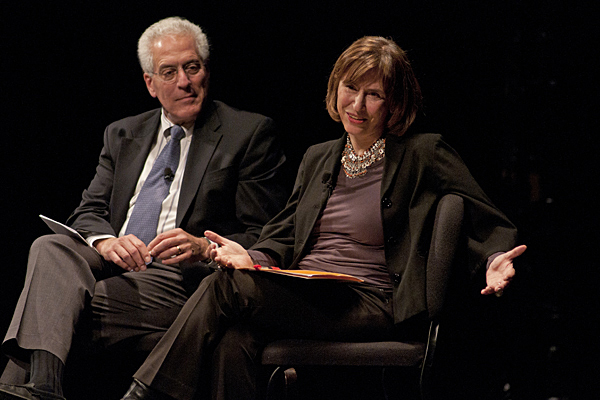
“But no one can take your memories -- literature and your imagination safeguard them,” Nafisi said to an audience of nearly 300 during her International Education Week lecture at the University of Delaware’s Mitchell Hall on Tuesday, Nov. 15.
Global Stories

Fulbright awards
Peace Corps plans
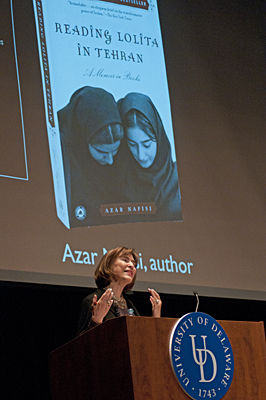
Nafisi, a professor at Johns Hopkins University who wrote The New York Times bestseller Reading Lolita in Tehran: A Memoir in Books, keyed on the importance of imagination as a force for discovery and freedom in the two countries she now calls “home” -- Iran and the United States.
Iran’s view of the world, and the world’s view of Iran and its culture, unfortunately have been reduced to religion at its most extreme, she said.
“This reductionism has really bothered me,” said Nafisi, who earned her doctorate in English literature in the U.S. and then returned to Iran in 1979 to teach at the University of Tehran at the beginning of the Iranian Revolution. As the ruling monarchy was overthrown and the Islamic Republic of Iran was formed, many women’s rights began to be taken away. The age of marriage was lowered from 18 to 9 years of age for girls. The new regime brought stoning as a capital punishment, and also enforced the veil, with 86 lashes for women not wearing it, she said.
“Iran was the cradle of civilization — how dare a group of people call such shameful acts their culture?” Nafisi said, pointing out that Persia has some of the most beautiful and erotic poetry and dancing in the world, and that some of the world’s most dynamic feminists have come from the region. “We had women engineers, poets, doctors – not because they looked to the West, but because they had a history of it.”
Nafisi was expelled from teaching at the University of Tehran in 1981 for refusing to wear the Islamic veil and did not resume teaching until 1987.
“The issue of the veil was about the right to choose,” Nafisi said, noting that her mother never wore one, but her grandmother, an orthodox Muslim, never took off her veil. “Who is to say who is more Muslim? Women in Iran are not fighting religion, culture and tradition, they are fighting for freedom of choice -- that the state has no right to tell a woman how to dress.”
As written about in her book Reading Lolita in Tehran, Nafisi invited seven of her female students to attend regular meetings at her house every Thursday morning in Iran. They would study works such as Lolita, censored by the government, along with books by F. Scott Fitzgerald, Jane Austen, Mark Twain and other legendary authors.
“Only through imagination and thought do you break the boundaries,” Nafisi said. “My Iranian students read Tocqueville, Emily Dickinson, Elizabeth Bishop — when the world was taken away from them, they connected through their best ambassadors: the poets, the writers.”
Nafisi implored the audience not to take their freedom of expression or their institutions of learning for granted.
“George Washington thought this country should be known by its institutions of learning,” she said, emphasizing that the humanities and the liberal arts are critical to both understanding the world and to innovation.
“Could Steve Jobs have lived in China?” she asked. “Why does China now want to have liberal arts colleges? What gives this country [the U.S.] its strength is not its military power, but its democratic imagination.”
Nafisi shared her dream of Americans from across the U.S. converging on the National Mall to support what lies between the Capitol and the monuments -- “the great Smithsonian Institution, with its science and art.
"Museums, libraries, all these things can be taken away at the drop of a hat,” she said, noting that the government recently reduced funding for the iconic institution. “Then, I hope we won’t have a protest, but a national conversation on who will bail out imagination and thought.”
Article by Tracey Bryant
Photos by Duane Perry