








Diversity workshop on grant writing
Ask and you shall receive? A superior application makes all the difference


9:37 a.m., Dec. 6, 2011--You have to ask for funding to receive funding, and you need to put your very best foot forward in doing so, University of Delaware students were reminded at the diversity workshop on grant writing on Nov. 30.
Sponsored by the Office of Graduate and Professional Education, the McNair Scholars Program and the Network of Undergraduate Collaborative Learning Experiences for Underrepresented Scholars (NUCLEUS), the student response to the workshop was so great that the event had to be moved from Gore Hall to an auditorium in Smith Hall. There, University presenters provided guidelines for developing stellar proposals for fellowships, scholarships and research funds from private foundations, federal agencies and other funding sources.
Research Stories

Chronic wounds
Prof. Heck's legacy
P. Gabrielle Foreman, who joined the UD faculty earlier this year as the Ned B. Allen Professor of English and professor of Black American Studies, pointed out how students should look at procuring such grant funding like a job, methodically keeping online notes or index cards on opportunities they come across, networking with other students seeking similar opportunities, and joining listservs relevant to their field to learn about prospects.
Foreman also underscored the importance of cultivating letters of support that aren’t just good, but great. Too often, she said, she has seen letters of support that are too short, do not speak to the discipline of focus or are otherwise underwhelming, sending otherwise excellent applications into the “no” pile.
“Only ask for them from professors for whom you have done your very best work. You need them to say without hesitation ‘this was one of the best students I have ever had in my class,’ or ‘one of the best three researchers I ever worked with.’ This is how you excel, how you get jobs—you need to do superior work,” Foreman noted.
In addition to external fellowship and scholarship opportunities, Charlie Riordan, vice provost for graduate and professional education, pointed out that the University offers a number of internal fellowships available at the master’s and doctoral levels. Students must be nominated for these by their program.
Riordan urged students to begin the application process early and to not ignore basic formatting guidelines such as font sizes and margin widths, which, when not followed, can automatically disqualify applicants.
Riordan also told the students to prepare to be rejected and to not let it get them down. In 2011, for example, the National Science Foundation awarded 2,000 Graduate Research Fellowship awards across the United States from 12,000 applications, for a 17 percent success rate.
“Let the scholarship opportunities drive you, jazz you up,” Riordan urged. “Align your passions and interests to the appropriate funding agency. They want to pick winners. Are you going to be a leader?”
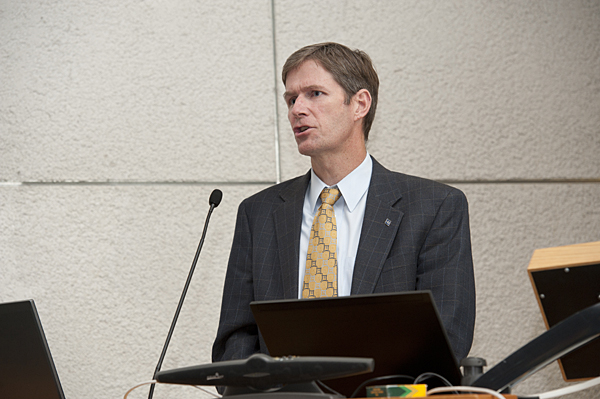
In an informative and humorous presentation, Carlton Cooper, assistant professor of biological sciences, shared his advice about proposal development and the importance of faculty mentors. Carol Rudisell, librarian in the Reference Department at the University Library, provided key resources for seeking funding and for writing competitive proposals and reminded students that many private foundations do not have websites.
“So if you rely on Google, you will miss out on a lot of potential funders,” Rudisell said, noting that the University Library is a good place to start your search.
Article by Tracey Bryant
Photos by Evan Krape