|
Alcohol education required for all first-year students
 |
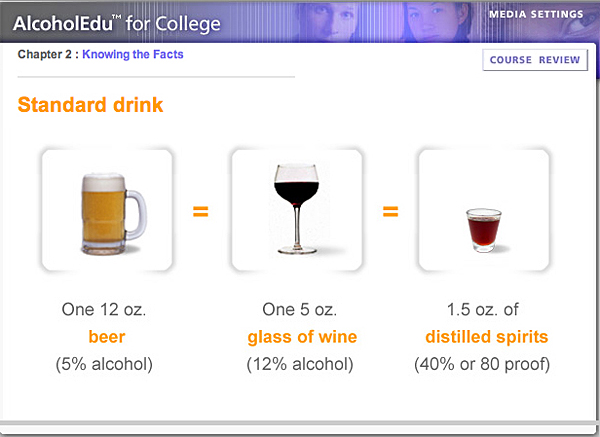
| Research shows that students do not know how much alcohol is in one drink. AlcoholEdu for College educates students about a “standard drink,” or the specific amount of beer, wine or liquor that contains the same total amount of alcohol. This knowledge helps students better understand concepts like blood alcohol concentration (BAC). |
8:57 a.m., June 30, 2006--All incoming first-year students at UD are now required to take an online alcohol education program, AlcoholEdu for College. The course is being introduced to new students attending DelaWorld this summer.
The course is aimed at creating a learning experience that motivates behavior change, resets unrealistic expectations about the effects of alcohol, links choices about drinking to academic and personal success, and helps students practice healthier and safer decision-making.
First-year students who do not complete the online course will not be able to register for spring semester classes.
 |
| Tracy Downs (left), program director at UD’s Center for Counseling and Student Development, discusses AlcoholEdu for College with parent Debi Clausen of Middletown during a break at DelaWorld, a one-day orientation for new students and their parents. |
"Requiring all first-year students to complete AlcoholEdu is just one more tool we have in our efforts to reduce the problems related to high-risk drinking," Tracy Downs, program director at UD's Center for Counseling and Student Development, said.
Used on more than 450 college and university campuses nationwide, the course is designed as a population-level prevention program to be given to an entire population of students, such as an entering first-year class or a national Greek organization.
More than 250,000 students nationwide have taken AlcoholEdu for College, producing the world's largest database on college students and alcohol based on their responses to course surveys.
Data from students who completed the program in summer and fall 2004 showed that AlcoholEdu for College:
- Increases practical knowledge--71 percent said they now know more about blood alcohol concentration and 44 percent of men know more about how alcohol affects consent for sex;
- Motivates students to change behavior--The percentage of heavy-episodic drinkers who did not see a need to change their behavior dropped by almost 30 percent after AlcoholEdu and the percentages of students who were trying to change doubled; and
- Decreases negative consequences--For the entire 2003-04 academic year, students who took the program had significantly fewer negative personal, health and academic consequences.
An independent evaluation of AlcoholEdu for College by Andrew Wall at the University of Illinois at Urbana-Champaign showed that students who completed AlcoholEdu experienced a 50 percent reduction in negative academic and personal consequences, such as missing class, blacking out, having unprotected sex and vomiting in public.
“Our primary reason for making this population-level effort to focus on alcohol education is simply the concern we have about the health and safety of our students,” John Bishop, UD associate vice president for counseling and student development, said.
AlcoholEdu is part of a broader effort at UD to combat underage drinking and drug abuse, funded in part by a $1.2 million three-year federal grant.
Article by Martin Mbugua
Photo by Kathy F. Atkinson
 E-mail this article E-mail this article
 Subscribe to UDaily Subscribe to UDaily
 Subscribe to crime alert e-mail notification Subscribe to crime alert e-mail notification
|