|
|
|
|
|
|
|
|
||||||||||||
|
|
|
Dedication keeps UD wired to the world 24/7/365
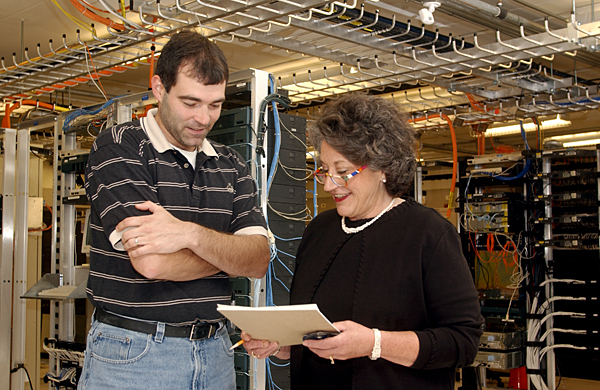
The center—and the employees who keep it running—ensure the University’s network and computers are running, allowing for uninterrupted access to the Internet by UD students and employees 24 hours a day, seven days a week, 365 days a year. “I’ve been here at 8 p.m. on Christmas Eve,” Shirley Coen, manager of IT’s Network and Systems Services (NSS), said. “We get phone calls from users reporting problems 24 hours a day, seven days a week.” According to Mel Rau, NSS associate manager, such hours aren’t at all unusual for a job that’s driven by computers and thousands of end-users. The wires, circuits and machinery that enable students and employees to communicate via e-mail, connect to the Internet, handle UD transactions, check grades, reserve books and generally conduct campus business at the click of a button, not surprisingly require constant monitoring and maintenance, he said. “We’re here around the clock, and have to monitor the systems constantly,” Rau said. “I’d say we work 50-hour weeks, because that’s what’s expected. When there’s a problem in the middle of the night, you get up, you fix it and you go back to bed, because people rely on that.”
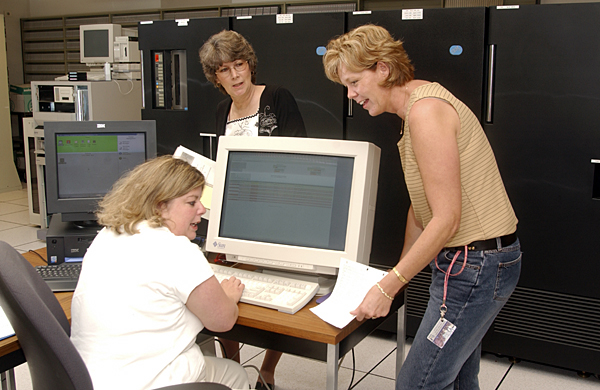
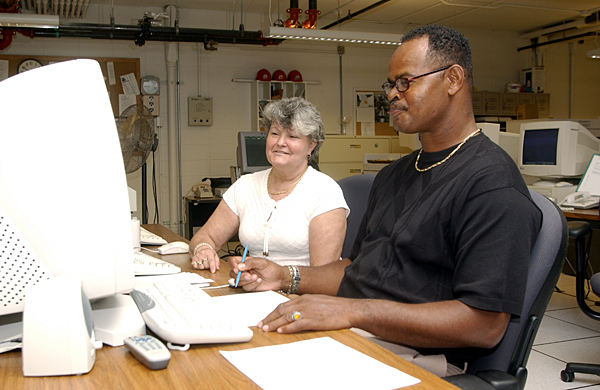
This approach carries into all functions of the Computing Center, including the operations department—a department that’s particularly critical to electronic transactions across campus. The first in line to spot problems, nine operators working in three shifts—the first from 7:30 a.m.-3:45 p.m.; the second from 3:30-11:45 p.m.; and the third from 11:30 p.m.-7:45 a.m.—monitor network activity and handle potential snarls, while three production control analysts are on call 24 hours a day, seven days a week, 365 days a year. “If a problem comes up, reports are generated by an operator on duty, and since production control analysts are always on call, one of us is alerted,” Mike Cummings, production control analyst, said. Depending on the nature of the report, Cummings said, problems are then either fixed or routed to the next level.
“It’s a working family situation here, and everyone has to respect everyone else’s talents and abilities,” Coen said. “When problems arise, fixing them may not be someone’s area of expertise, but sometimes just making coffee to keep everyone going is a big help. We maintain a very collaborative environment.” Rau agrees. “The management staff members in this building do every bit as much work as everyone else. It’s very hands-on. That’s what makes the group work so well. When a machine goes down, everyone does what needs to be done to get things going again. We all work together: Someone’s checking for spare parts, while someone’s on the phone, while someone else is testing connections. Typically, when a machine goes down, we have it back up and running in an hour.” Susan Foster, vice president of Information Technologies, agreed. “The network, systems, and operations groups are the unseen essentials to everyday life at the University,” she said. “Without their constant care and diligence, nothing else that IT does would matter.” Coen is equally proud of the way dedication and efficiency at the center impact the University community. “When you turn on your computer every day, you don’t think about problems. When problems occur, that’s probably the only time many people on campus know we exist,” Coen said. “There are other callers who know only too well that we’re here around the clock. We have a professor who is very dedicated to calling up between 4 and 6 a.m. just to let us know that e-mail is running slowly.”
With so many requests—urgent and otherwise—the pace can sometimes get intense, but keeping a sense of perspective and humor always helps. And, no matter how high-tech the equipment gets, humans will always be human. “One of the questions I’m always getting asked is whether we can read e-mails,” Rau said. “For some reason, people think that network administrators sit around all day reading people’s e-mail. I’ll be honest with you: We don’t have that kind of time.” Article by Becca Hutchinson To learn how to subscribe to UDaily, click here. |
|
|