11:35 a.m., Feb. 21, 2003--Sima Samar, head of Afghanistan's Independent Human Rights Commission, recounted firsthand Thursday Afghanistan's current political state as well as its future at two campus presentations, focusing her speech on human and women's rights.
"Justice needs to be restored," she said. "There has been no justice [in Afghanistan] in the past 24 years. We want the international community to support points like women's and human rights and education because we are not able to do it on our own."
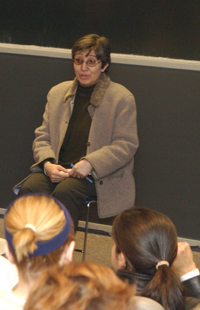 |
| Sima Samar, head of Afghanistan's Independent Human Rights Commission: “We want the international community to support points like women's and human rights and education because we are not able to do it on our own." |
Samar, a lifelong human rights activist in the Islamic worlds of Afghanistan and Pakistan, was briefly appointed Minister of Women's Affairs of Afghanistan last December when the Taliban regime was overthrown and an interim government replaced it. But traditional tribal political stances against women forced her out of office quickly last summer, and she is now head of Afghanistan's Independent Human Rights Commission.
"There were a lot of attacks on me, but [women] are half of society," she said. "We cannot move forward if half of society is put aside."
In order to prepare listeners to understand her background, Samar recounted the political history of Afghanistan, including the rise of the Taliban regime, which came into power in 1994.
"Their promise was to unite the country," she said, "but this was not the case. They took over."
Women were perhaps hit hardest by the strict rules of the system. Women were not allowed to have a career, go to school, show their faces or leave their home. Samar fought against the Taliban's edicts by running a high school for women—the only one that existed for women at the time.
In addition, the Taliban outlawed women from watching television, closed public baths for women's use and forbade girls to play with toys that made noise. Samar stressed that the religion of Islam is a very peaceful one, and the Taliban exercised a strict and radical interpretation of it.
"[Women] had to wear the burqa. They were not even allowed to wear high-heeled shoes because the sound would disturb men on the street," she recounted. "Even a kite was not allowed because it resembled a bird. [The Taliban] have something against nature. Their beliefs did not have logic, especially in this century."
Education was a key part of Samar's presentation. She spoke of Afghanistan's current state of poverty and the effect that has had on schooling. Because national police do not exist in Afghanistan, people loot school buildings, stealing chairs and other materials and breaking windows, she said. In addition, most of the buildings lack electricity.
"Yes, the girls are allowed to go to school now, but there's lack of facilities—no buildings, no books," she said. "We should not repeat the same mistakes that we did before. Whether we are able to wear high heels now or not, if you're uneducated the problems will be far-reaching."
Samar emphasized the importance of focusing not only on women's issues but human rights issues as a whole.
"Everybody remembers what happened here Sept. 11, which was a crime against the world. Nobody will forget that," she said. "But before that, no one was concerned with women in Afghanistan. After that everything changed.
"The other important issue is humanity. [Afghanis] should be treated as human beings, not just as the political interest of other countries."
Samar said Afghanistan is working to form a democratic government that includes the principles of Islam and the international standards of human rights. A constitution is currently under development.
"We would like to have a system where the people can choose and take part," she said. "The government should be accountable for all people. We are struggling to build that. The international community needs to give support so Afghanistan can come out of this."
Afghanis' opinions of Americans have changed over the past year, Samar said. She said Afghani citizens were happy at the first arrival of Americans after Sept. 11 last year, but now most people do not understand some American policies—like the bombing of civilians.
"[Afghanis] think [Americans] are only looking for Bin Ladin," Samar said, "and when they find him they will go away and leave us alone."
Samar urged listeners to change this viewpoint by pressuring the American government to help Afghanistan rebuild its economy instead of sending in more and more troops. Afghanis need basic health care and educational facilities, she said.
Samar's apearance was part of UD's “America and the Global Community Initiative,” which is part of a series of speeches designed to build stronger and more direct connections between the University and the global community. The initiative is organized by Ralph Begleiter, Edward F. and Elizabeth Goodman Rosenberg Professor of Communication.
For more information, visit [http://international.udel.edu/newsevents/currentnews.html].
Article by Amie Voith, AS 2003
Photo by Kathy Flickinger
|